Planning accurate wedding flower quantities is one of the most important skills a professional florist develops. A clear wedding flower quantity guide helps florists estimate the number of stems needed for bouquets, centerpieces, ceremony décor, and large installations, while avoiding costly over-ordering or shortages.
Wedding flower quantities refer to the number of stems required to create specific arrangements such as bouquets, centerpieces, arches, aisle décor, and floral installations. Accurate estimates help florists plan wholesale orders, calculate pricing, and organize event production.
Florists who regularly design weddings quickly learn that planning for flower quantities affects profitability, logistics, and design execution. Even small errors in estimating flower counts can affect budgets, timelines, and the final visual result.
Experienced wedding florists often develop their own reference charts for wedding flower quantities based on arrangement style, flower type, and event scale. These charts help them estimate stem counts quickly while maintaining consistency across events.
Table of Contents
Wedding Flower Quantity Guide Overview
Why Wedding Flower Quantities Matter
Wedding Flower Quantities for Bouquets
Wedding Flower Quantities for Centerpieces
Wedding Flower Quantities for Ceremony Arches
Wedding Flower Quantities for Aisle and Ceremony Decor
Wedding Flower Quantities for Bud Vases
Wedding Flower Quantity Planning Strategy
Manual Flower Planning vs System Planning
Common Wedding Flower Quantity Mistakes
Frequently Asked Questions
Wedding flower quantities vary depending on bouquet size, centerpiece design, flower variety, and event scale. This guide explains typical stem counts used by professional wedding florists when planning bouquets, centerpieces, arches, and ceremony decor.
This wedding flower quantity guide helps florists estimate the number of stems needed for bouquets, centerpieces, arches, and ceremony decor, enabling accurate event planning.
Wedding Flower Quantities for Bouquets
This wedding flower quantity guide outlines typical stem counts for common wedding arrangements. These numbers provide a helpful starting point for florists planning proposals and production schedules.
Actual quantities vary depending on flower variety, arrangement style, and design density. Large blooms require fewer stems, while delicate flowers require higher quantities to achieve fullness.
Why Wedding Flower Quantities Matter
Accurate flower quantity planning supports several important parts of the wedding floral workflow.
- Wholesale ordering accuracy
- Proposal pricing calculations
- Production planning
- Recipe organization
- Design consistency
When florists estimate quantities correctly, they avoid last-minute flower shortages and reduce unnecessary over-ordering.
Many florists organize inquiries, proposals, pricing, and event planning using florist CRM software that keeps the entire wedding workflow in one place.
Wedding Flower Quantities for Bouquets
Bridal bouquets are typically the most detailed arrangements in a wedding floral order. The number of stems depends on bouquet size and flower variety.
Typical Bridal Bouquet Quantities
- Garden roses: 5 to 7 stems
- Standard roses: 9 to 15 stems
- Peonies: 3to 7 stems
- Mixed seasonal bouquet: 20 to 35 stems
Bridesmaid Bouquet Quantities
- Standard roses: 10 to 15 stems
- Garden roses: 8 to 12 stems
- Mixed seasonal bouquet: 12 to 18 stems
Florists often design smaller bridesmaid bouquets to complement the bridal bouquet while maintaining visual balance.
Many florists organize bouquet recipes using structured design guides, such as the floral recipe builder approach.
Wedding Flower Quantities for Centerpieces
Centerpieces vary widely depending on design style and vessel size. Low arrangements typically require fewer stems, while tall arrangements require more structural elements.
Low Centerpiece Flower Quantities
- Standard roses: 8 to 12 stems
- Garden roses: 6 to 10 stems
- Mixed seasonal flowers: 10 to 15 stems
Tall Centerpiece Flower Quantities
- Focal flowers: 6 to 8 stems
- Secondary flowers: 8 to 12 stems
- Filler flowers: 5 to 8 stems
- Greenery: 5 to 10 stems
Florists typically calculate centerpiece quantities while building event proposals. A structured proposal format helps organize these quantities clearly. See the florist proposal format here:
Wedding Flower Quantities for Ceremony Arches
Floral arches require larger quantities because they cover wider structures and must remain visually balanced from multiple viewing angles.
Typical Arch Flower Quantities
- Small arch cluster: 40 to 60 stems
- Medium floral arch: 70 to 120 stems
- Full floral arch coverage: 150 to 250 stems
Large installations may include greenery, foam mechanics, and structural supports to create stable designs.
Florists often review ceremony layouts during the florist consultation process.
Wedding Flower Quantities for Aisle and Ceremony Decor
Ceremony décor may include aisle markers, pew flowers, chair flowers, or small arrangements attached to ceremony structures.
Aisle Flower Quantities
- Chair flowers: 3 to 6 stems each
- Pew markers: 4 to 8 stems each
- Mini aisle arrangements: 6 to 10 stems each
The number of aisle arrangements depends on the ceremony layout and aisle length.
Wedding Flower Quantities for Bud Vases
Bud vases are increasingly popular for modern wedding centerpieces because they create a light, organic design style.
Typical Bud Vase Quantities
- Single flower: 1 stem
- Mini cluster: 2 to 3 stems
- Mixed bud vase: 3 to 5 stems
A common wedding table design features three bud vases per table, each with a different flower variety.
Wedding Flower Quantity Planning Strategy
Florists often follow a structured planning process when calculating flower quantities for an event.
- Review the consultation notes
- List all floral pieces
- Estimate stem counts per arrangement
- Multiply by event quantities
- Add buffer stems for breakage and adjustments
Accurate planning helps florists maintain profitability when calculating flower costs.
See a detailed pricing strategy here:
Manual Flower Planning vs System Planning
Many florists begin their careers planning wedding flowers using spreadsheets, notebooks, and handwritten design notes.
While this method can work for small events, larger weddings require more organized systems.
Manual Planning
- Spreadsheets for flower lists
- Separate proposal documents
- Manual pricing calculations
- Disconnected client communication
System-Based Planning
- Integrated client records
- Automated proposal generation
- Organized floral recipes
- Structured event planning
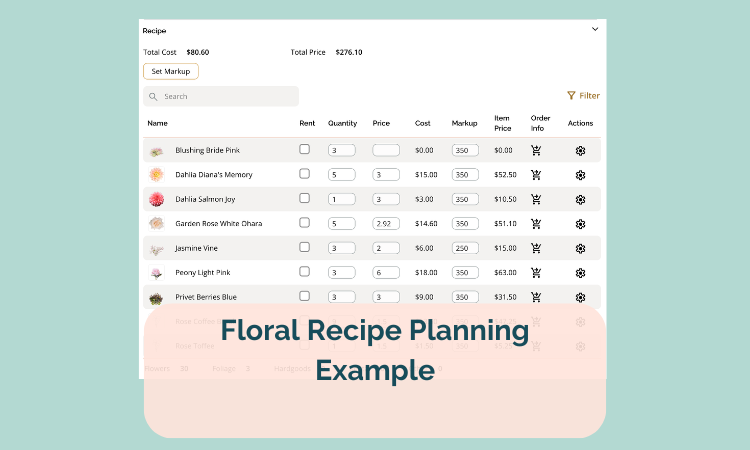
Many florists adopt CRM platforms to streamline these processes.
Common Wedding Flower Quantity Mistakes
Even experienced florists sometimes make mistakes in quantity estimation when planning large events.
- Underestimating flower density
- Forgetting extra stems for breakage
- Ignoring venue scale
- Under ordering greenery
- Not accounting for last-minute design adjustments
Using a clear quantity planning system helps avoid these common mistakes.
Frequently Asked Questions
How many flowers are in a bridal bouquet?
A bridal bouquet usually contains between 15 and 30 stems, depending on the bouquet size and flower variety.
How many flowers are used in wedding centerpieces?
Low centerpieces typically contain 8 to 15 stems, while larger arrangements may contain 15 to 25 stems.
How many flowers are needed for a wedding arch?
Small arch clusters may use 40 to 60 stems, while full floral arches can require 150 to 250 stems.
How do florists calculate wedding flower quantities?
Florists estimate flower quantities by determining stem counts per arrangement and multiplying those counts by the number of arrangements required for the event.
Conclusion
Understanding wedding flower quantities helps florists plan events accurately, control costs, and create consistent floral designs.
By organizing bouquet counts, centerpiece recipes, and installation quantities in advance, florists can confidently prepare wholesale orders and production schedules.
Modern florists often combine traditional design knowledge with digital planning tools to simplify event management.
If you want to streamline your entire workflow from inquiry to installation, explore how True Client Pro helps florists organize proposals, recipes, pricing, and event production in one system.